History
Did you know the Tabor Opera House was deemed a National Treasure by the National Trust for Historic Preservation? Read on to learn about the impressive building—and colorful characters—who have helped the Tabor stand the test of time.
1879-1893
Mining magnate Horace (H.A.W.) Tabor built the opera house in 1879 in just 100 days, to bring arts and culture to a cold, remote mining town. Now the highest-elevation city in North America, at 10,152’, Leadville, Colorado, was then one of the West’s rowdiest silver boomtowns.

An Elegant Tabor Opera House
Tabor had a big job. The building materials he wanted weren’t available in Leadville, so he had them brought by wagon over Colorado’s highest, roughest passes. He built a massive three-story opera house made of stone, brick, and iron, trimmed with Portland cement. Its solid brick walls stand 16 inches thick!
In 1879, the building included two retail stores on the first floor, an elegant theater on the second floor, and a third floor with an enclosed skywalk to the Clarendon Hotel. The hotel, now gone, stood directly to the south, on the current gas station site.
The Tabor’s ornate interior boasted richly painted walls and ceiling frescoes, custom carpets, and hand-painted stage curtains. The red, gold, white, and sky-blue colors glowed. The first gas lights to illuminate Leadville—flowing from 72 jets—revealed the opera house’s beauty.

Luminaries on Stage
Despite building an impressive opera house at breakneck speed, Tabor did not pack the house on opening night—more people attended a hanging across the street.
Eventually, the Tabor became known as the finest opera house west of the Mississippi. Luminaries such as Oscar Wilde, John Philip Sousa, and Buffalo Bill appeared at the Tabor. So did live tigers, when a circus act came to town.
Magician Harry Houdini is said to have disappeared through the stage’s trap door. Of course, we’re not sure if that’s fact or fiction. Like the master himself, evidence of Houdini’s presence at the Tabor vanished.
1893-1901
As the price of silver dropped, so did HAW Tabor’s fortune. In 1893, Judge A.S. Weston bought the Tabor Opera House for $32,000 when the Tabors defaulted on a note to banker A.V. Hunter. In mid-1894 at the urging of friends, Judge Weston renamed the Tabor the Weston Opera House and operated it until his death in early 1897. The judge’s widow Letitia B. Weston continued to operate it. Mrs. Weston was reportedly one of only three women theater operators in the country and was producing 10-15 shows per month. In 1899, the Weston Opera House was foreclosed on again, and J. W. Doyle of the Portland Mine in Cripple Creek bought it. Mrs. Weston continued to operate the business until 1901, when Mr. Doyle sold to Dr. J. H. Heron on behalf of the Leadville Elks Lodge.
1901-1955
The Leadville Elks Lodge B.P.O.E. No. 236 formed The Leadville Elks Building Association with funds raised by selling shares to the Lodge members. In early 1901, they purchased the Weston Opera House from Mr. Doyle for $12,500 and renamed it The Elks Opera House. They hired Architect A.G. Higgins of Pueblo to design a complete remodel in 1902—the last remodel the building has had! On July 17 a general contract was awarded to Albin E. Schmidt for $17,321. Mr. Fred Megan of Kansas City Scenic was contracted to provide a complete set of drop curtains and scenery for the new larger stage at a cost of $1,135. By July 1902, the Elks Opera House remodel had begun, overseen by A.V. Bohn, President of the Leadville Elks Building Association. The grand opening of the new Elks Opera House was held on December 11, 1902, with a performance of Florodora and a minstrel show.
The Elks Opera House had been completely remodeled and enlarged with a 30’ addition to the east end of the building, creating the larger stage and dressing rooms that exist today. Floor levels were changed, and the auditorium was enlarged. The third floor was lowered, removing hotel rooms that had been connected by an elevated walkway to the Clarendon Hotel, which once stood next door. A combination ballroom and lodge room with an attached lounge were added to this floor.
Mr. George W. Casey managed the opera house for 14 years. The Elks continued to own and operate the opera house, through the First and Second World Wars, the Great Depression and the advent of moving pictures. They struggled financially and finally rented the auditorium to theatrical producers and then to movie companies. They rented the storefronts to various businesses and housed the Red Cross during the Second World War. Other fraternal organizations such as The Grand Army of the Republic and the Royal Arcanum held their meetings at the opera house.
In 1955, the Elks sold the building for $20,000 to Mrs. Hollister and her daughter Evelyn Furman. The second and third floors were to be leased back to the Elks while they built their new home on 5th Street, where it remains today.
1954 – 2016
In 1954, a tenacious Leadville businesswoman—at a time when it was not in vogue for a woman to own a business—took over the Tabor Opera House.
Pioneer Evelyn Furman
Evelyn Livingston Furman (1913 to 2011), arrived in Leadville as a nanny for the summer of 1933, to tend children and learn about geology. Instead, she fell in love with Leadville and a miner named Gordon Furman and chose to stay in this boom and bust mining community.
She and Gordon lived for a while in a miner’s cabin just above the famous Matchless Mine where Baby Doe still lived. Soon after their marriage, Gordon lost his right arm in a mining accident. To add to the household income, Evelyn borrowed money from her mother-in-law to buy a Maytag wringer washer. She went door to door until she sold that machine. Then she bought two and sold those, too. Over the years, she became a premier dealer for Maytag, Hoover and Drexel.
At the time, the Elks owned the Tabor Opera House. When the Elks placed it on the market in 1954, Evelyn’s love for history, her eye for the restoration of past treasures, and her pioneer spirit that believed she could accomplish anything pushed her to bid on it.
The Elks voted to sell it to her, and owning the Tabor became a 59-year adventure for Evelyn and her family. She personally ran the Opera House until she was 84 years old. She then turned the control over to her daughter, Sharon Furman Bland, and Sharon’s husband Bill.
Evelyn never stopped loving the Opera House and the story of the Tabors. She wrote three books that you can still buy at the Opera House. These books tell the story of the Opera House, Augusta Tabor, and Silver Dollar Tabor. Evelyn, who cruised around the world three times, even flew to France to meet Augusta Tabor’s relatives to research the books.
Evelyn received many accolades during her 98 years of life, including a 2007 Colorado Preservation, Inc. award. People still visit the Opera House and speak fondly of her love for people and history. She truly epitomized the pioneer spirit—and Leadville’s proud, gritty culture—that has helped the Tabor Opera House to become an icon.
2016 – Present
In late 2016, the City of Leadville bought the building from the Bland family for $600,000, using money raised entirely through grants.
The Tabor Opera House Preservation Foundation (TOHPF), a nonprofit 501(c)(3) founded in 2003 to assist the previous owners in caring for this historic building, was reorganized and its mission expanded to raise funds for rehabilitation and to operate the building on behalf of the Leadville/Lake county community.
In early 2017, the Tabor Opera House Preservation Foundation signed a 50-year lease and renewable 10-year operating agreement with the City of Leadville to lead the rehabilitation and operate the building. In 2017, the inaugural season launched with ballet, opera, Broadway, blues, jazz, rock, homegrown community theater and the Colorado Songwriter Showcase. After a two-year pandemic hiatus, events featuring regional and national talent resumed in 2022.
Hidden Treasure
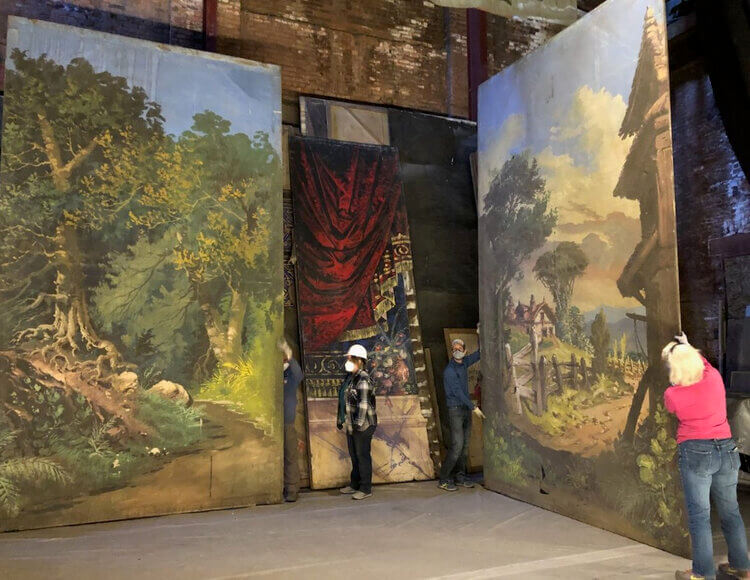
In 2020, historic stage scenery expert Wendy Waszut-Barrett, Ph.D., visited the Tabor and explored its upstairs. Much to her surprise, and ours, she found hand-painted curtains and drops dating as far back as 1879. These pieces, plus historic stage scenery, had been stored behind other collectibles for well over a century.
A Multi-Year, Multi-Million Dollar Rehabilitation
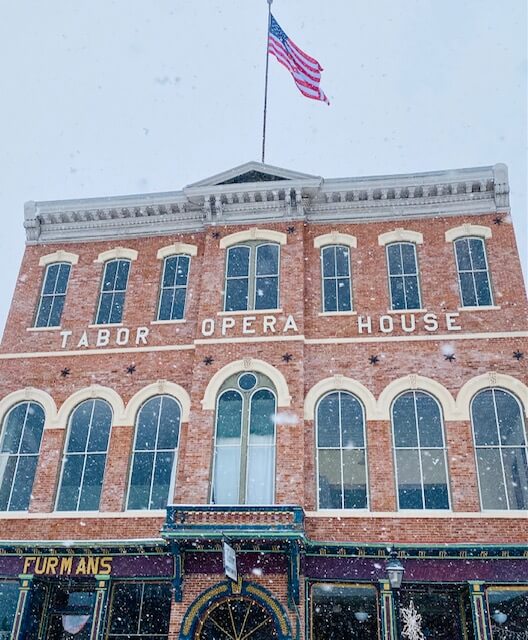
In 2020, the Tabor Opera House Preservation Foundation launched a historic rehabilitation to save the Tabor. Over the summers of 2020 and 2021, skilled construction crews rehabilitated the most badly damaged exterior walls, the south and west elevations. The team repaired brickwork, restored windows and doors, and stabilized the south storefront columns. In the summer of 2023, work will continue on Phase 2, to rehabilitate the east and north exterior walls.
A future phase of rehabilitation will take us inside the building to rehabilitate the performance hall, dressing rooms, north and south retail spaces, and the Tabor Suite and Ballroom. To accommodate uses for the 21st century and beyond, an elevator will be added to serve all floors, and a new heating system will be installed. The Tabor Opera House Preservation Foundation is currently fundraising to pay for the development of the interior plans.
Shows & Tours at the Tabor Today
Community members and visitors have enjoyed world-class shows like opera, theater, Broadway, blues, jazz, rock, flamenco dancing and ballet, community theater, and more on Tabor’s famous stage. The lights go up on nationally and regionally acclaimed talent, adding to the Tabor’s intriguing history. Join us for an event!
The opera house is also open for tours in from Memorial Day weekend through early fall. Visitors can sing from the stage, see the original marble-backed lightboard, touch Jack Dempsey’s boxing ropes, and hear their own footsteps crossing the grand ballroom.
At the Tabor Opera House, we’re excited to keep bringing these experiences to community members and visitors worldwide for centuries to come.
Sign up for our newsletter
Monthly-ish emails with Tabor news, events, and behind-the-scenes updates.